
The Body’s Domino Effect: How Avoiding Pain in One Spot Causes Injury Elsewhere

We’ve all been there. You tweak your knee on a morning walk or twist your ankle stepping off a curb. It hurts, but not enough to keep you in bed. So, you adopt the "tough it out" mentality. You limp a little, adjust how you sit, and carry on with your day. You figure if you just ignore it, it will eventually go away.
But weeks later, the original injury might feel better, yet suddenly your lower back is throbbing, or you’re waking up with a stiff neck.
This isn’t a coincidence. It is your body’s way of compensating.
At Curnyn Physical Therapy, we see this story unfold in our Fort Worth clinics every day. The body is an incredible, interconnected machine. When one part isn’t pulling its weight, another part has to work overtime to pick up the slack. Understanding this connection is the first step toward true recovery—and it’s why treating only the painful spot often fails to provide lasting relief.
The Kinetic Chain: You Are More Than Individual Parts
To understand why a foot problem can cause a headache, you have to understand the concept of the "Kinetic Chain."
Imagine your body as a series of interconnected links, spanning from your feet all the way to your head. This concept, originally described by Steindler in 1955, suggests that our joints and segments do not operate in isolation. Movement at one joint influences the movement at the joints above and below it.
When you walk, run, or even reach for a cup of coffee, you aren't just using a single muscle. You are engaging a complex sequence of events. If one link in that chain is stiff, weak, or painful, the energy doesn't just disappear. It gets transferred to the next link in the chain—often a link that wasn't designed to handle that specific load.
The Neighboring Joint Theory
One of the most common ways this manifests is through what physical therapists call the "Neighboring Joint" theory. This concept highlights how pain in a specific joint forces the joints directly above and below it to alter their mechanics to keep you moving.
Let’s look at the knee as a prime example. The knee is designed primarily for stability—it acts as a hinge. The ankle and the hip, however, are designed for mobility.
If you have a stiff or painful knee, you naturally limit its motion. But you still need to walk. So, your body demands extra movement from the neighbors. Your hip may have to rotate excessively to swing your leg forward, or your ankle might collapse inward to absorb the shock your knee usually handles.
The result? You might come in to see us for hip bursitis or plantar fasciitis, but during our evaluation, we discover the root cause is actually that old knee injury you thought healed years ago. This is why our experts at Curnyn PT take a comprehensive approach to your evaluation. We don't just look at where it hurts; we look at how you move.
The High Cost of an "Antalgic Gait"
The medical term for limping to avoid pain is an "antalgic gait." While it is a brilliant short-term survival mechanism to protect an injury, it is disastrous for your long-term biomechanics.
When you limp, two specific mechanical changes occur that wreak havoc on your spine:
1. The Short Stance Phase
To minimize pain, you instinctively spend less time on the injured leg. This is called a shortened "stance phase." While this protects the injury, it creates a choppy, uneven rhythm. Your body has to use rapid, jerky muscle contractions to stabilize you, rather than the smooth, fluid motions that distribute force evenly.
2. The Lateral Trunk Lean
This is the silent back-killer. To swing a painful leg forward without bending it fully (or to keep weight off it), most people lean their upper body to the opposite side. This shifts your center of gravity.
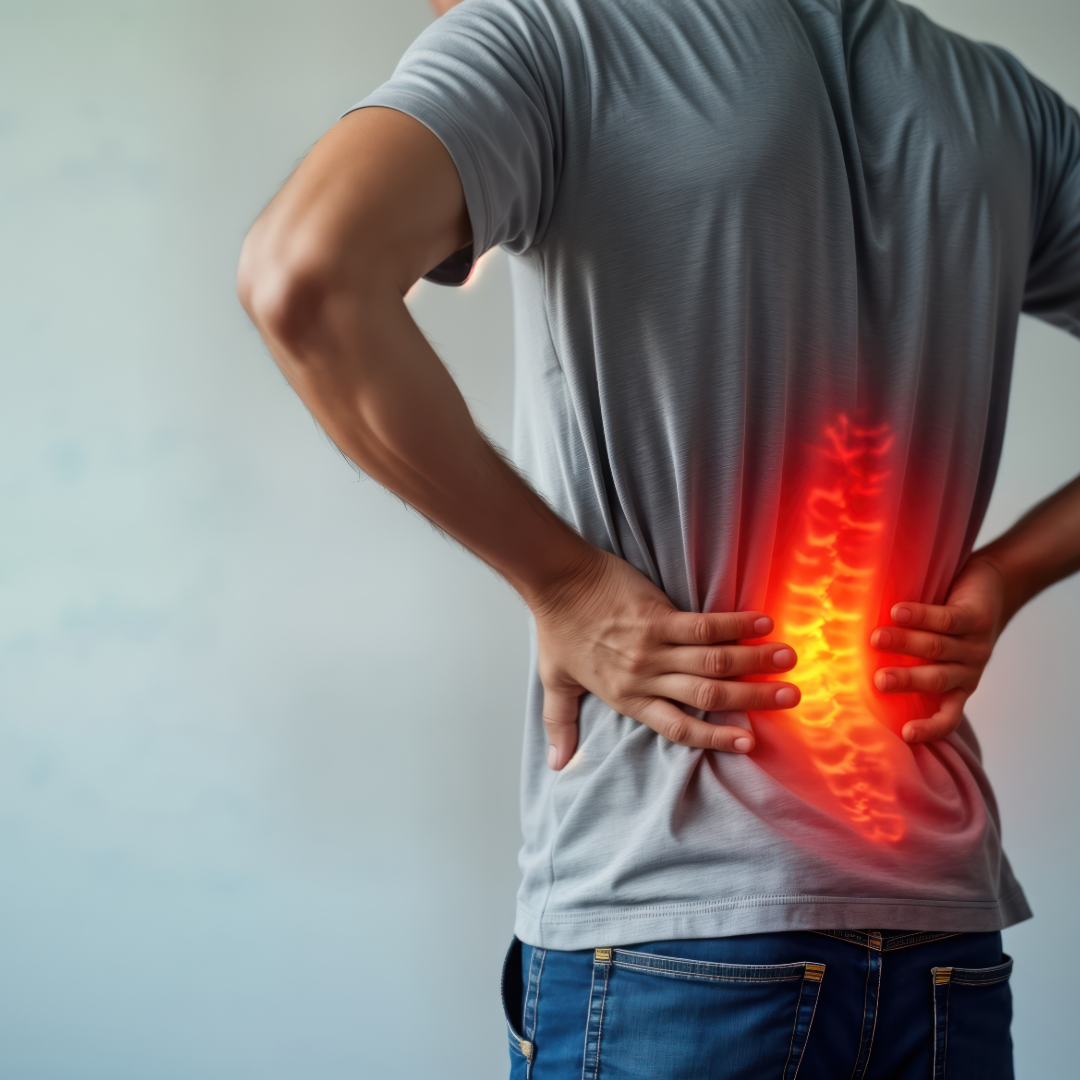
While this lean helps you take the step, it creates significant "shear force" across your lumbar spine. Your lower back discs are designed to handle compression (weight pushing down), but they are very poor at handling shear (forces sliding across). By walking with a lateral lean to protect a knee or ankle, you are essentially grinding your lumbar vertebrae with every step. This is often why a simple ankle sprain turns into chronic lower back pain months later.
The "Silent" Compensation: Arthrogenic Muscle Inhibition (AMI)
Sometimes, compensation isn't just about how you move, but about which muscles your brain decides to use.
When a joint is injured or swollen—particularly the knee—the body has a reflex known as Arthrogenic Muscle Inhibition (AMI). Essentially, the swelling disrupts the sensory feedback to your brain. In an attempt to protect the joint, the brain sends a signal to "shut down" or inhibit the surrounding muscles, most commonly the quadriceps.
Think of it as a circuit breaker tripping to prevent a fire.
However, you still need to walk and climb stairs. Since your primary mover (the quad) is inhibited, your brain recruits other muscles to do the job. You might start overusing your tensor fasciae latae (TFL) or your lower back extensors to hike your hip and swing your leg.
These muscles are not designed to be primary movers for walking. They are stabilizers. When forced to do the heavy lifting, they fatigue quickly, tighten up, and eventually become painful.
This is why rest alone rarely fixes the problem. You can rest until the pain is gone, but if that neural connection to the quad hasn't been re-established, you will continue to move with a compensation pattern. At Curnyn PT, our therapeutic movement plans focus on "waking up" these inhibited muscles to restore normal function.
The Domino Effect: From Foot to Neck
If we zoom out, we can trace the path of injury from the ground up. It is what we call the Domino Effect.
Consider a patient who has a rigid, high-arched foot or a lingering ankle issue.
The Foot: Because the ankle doesn't bend well, the patient can't step through fully.
The Pelvis: To compensate, they hike their hip or tilt their pelvis anteriorly (forward) to create false length in the leg.
The Spine: An anterior pelvic tilt forces the lower back into hyper-extension (swayback).
The Upper Back: To keep the eyes level with the horizon, the upper back rounds forward (kyphosis).
The Neck: The head juts forward to compensate for the rounded shoulders.
The Result: Tension headaches and jaw pain.
In this scenario, treating the neck might provide temporary relief, but unless we address the rigid ankle and the pelvic tilt, the headaches will keep coming back.
Don't Wait Until It Spreads
The most dangerous phrase in healthcare is often "I can live with it."
Living with a minor dysfunction means your body is constantly borrowing stability and mobility from other areas. Eventually, the debt comes due.
At Curnyn Physical Therapy, we have been keeping Fort Worth healthy for over 30 years because we understand these connections. We treat the person, not just the part. Whether you are dealing with a fresh injury or a nagging ache that has started to travel, you don't need to wait for a doctor's referral to get help. Texas allows "Direct Access" to physical therapy, meaning you can walk right in and start your recovery today.
If you are noticing that a knee problem is turning into a back problem, or a foot issue is causing hip pain, come see us. Let’s fix the root cause and get y'all back to feeling your best.