
Why Teachers' Necks and Backs Pay the Price Every School Year
The school year is back in full swing, and for many teachers, returning to the classroom means returning to the physical demands that come with it — long hours on their feet, bending over desks, and hauling heavy loads.
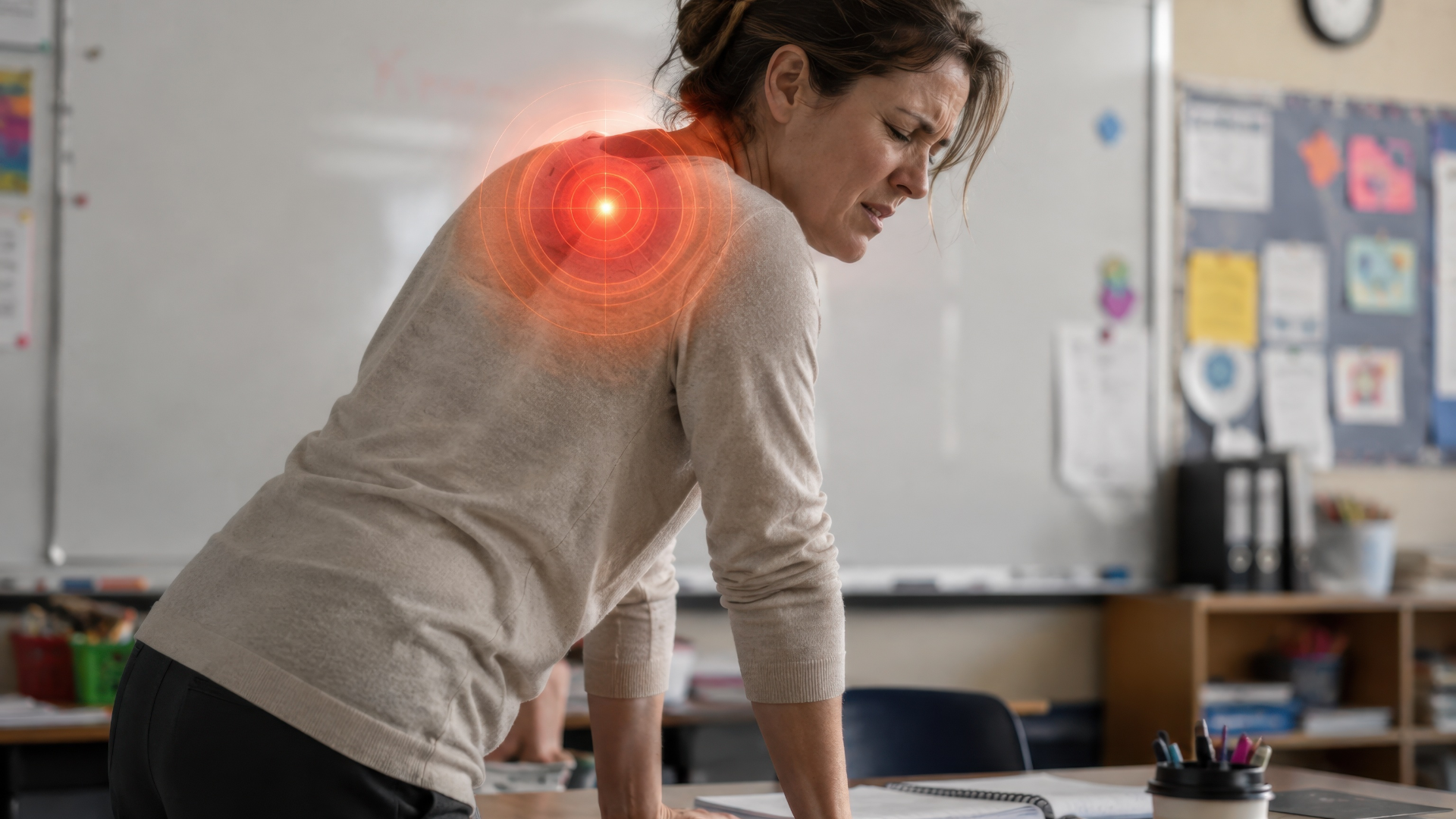
Teaching is physically demanding work. Leaning over desks at a 45-degree angle can place up to 49 pounds of additional force on the cervical spine, while standing on hard floors all day takes a serious toll on the lower back and pelvis.
This post breaks down the mechanics behind teacher neck and back pain, shares four targeted therapeutic techniques to help counteract the daily strain, and outlines when it's time to seek professional care.
Teachers shape the future. They also spend hours hunched over student work, craning their necks toward whiteboards and screens, and standing on concrete floors in classroom shoes that were never designed for eight-hour shifts. By the time a teacher sits down at the end of a school day, the damage to their cervical spine and postural muscles may already be done.
This isn't a minor inconvenience. Forward head posture and postural fatigue are cumulative conditions. Left unaddressed, what starts as end-of-day neck tension can progress into chronic cervical pain, radiating nerve symptoms, and long-term structural changes that require more than a good night's sleep to resolve.
At Curnyn Physical Therapy, we've served the Fort Worth community for over 30 years, and we see patterns emerge with the school calendar every single year. Teachers are among the most underserved populations when it comes to physical health. This post is for them.
How Does Leaning Over a Desk Cause Cervical Pain in Teachers?
The answer comes down to physics—and the weight of the human head.
At neutral alignment, your head weighs approximately 10–12 pounds. That's already a significant load for the cervical spine to manage. But as the head tilts forward, the effective load increases dramatically. According to a study published in Surgical Technology International, tilting the head forward just 45 degrees—the angle most teachers adopt while grading papers or reviewing a student's tablet—subjects the cervical spine to roughly 49 pounds of compressive force.
Do that for hours a day, across a 180-day school year, and the cumulative stress on the joints, discs, and muscles of the neck becomes substantial. The suboccipital muscles at the base of the skull become chronically shortened. The deep cervical flexors—the muscles designed to hold the head in proper alignment—grow weak from underuse. What follows is a predictable cycle: tightness, fatigue, pain, and compensation.
This is tech neck. And teachers—who spend their days navigating smartboards, tablets, and digital lesson plans—are among its most commonly overlooked sufferers.
What Does Standing All Day Do to a Teacher's Body?
Most people associate standing with being healthier than sitting. For short periods, that's true. But static standing—standing in one position for extended durations, as teachers often do while lecturing or managing a classroom—places a very different kind of demand on the body.
When the feet and legs fatigue from prolonged static loading on hard floors, the body doesn't simply give up and sit down. Instead, it compensates. The lower back and pelvis begin to shift their alignment to manage the load, causing the lumbar spine to take on stress it was not designed to bear continuously. As the pelvis tilts and the lower back fatigues, the upper back and neck are recruited to maintain upright head position. The result is a chain reaction—what physical therapists call a kinetic chain breakdown—where dysfunction in one region drives strain in another.
Teachers rarely connect their neck pain to their feet. But the connection is real, and treating the cervical spine in isolation—without understanding the full postural picture—is one of the reasons so many people don't get lasting relief from conventional approaches.
The 2-Minute Bell-to-Bell Reset: Four Techniques Every Teacher Should Know
The good news is that small, consistent interventions can make a meaningful difference. These four targeted techniques can be performed in a classroom, hallway, or break room. No equipment required—just two minutes between classes or during lunch.
1. Chin Tucks (Deep Cervical Flexor Activation)
Why it matters: Chin tucks directly reverse the mechanics of forward head posture. When teachers spend hours with their chin jutting forward, the deep cervical flexors switch off and the suboccipital muscles shorten. This movement reactivates the right muscles and gently decompresses the cervical joints.
How to do it: Sit upright with your feet flat on the floor. Look straight ahead. Without tilting your chin up or down, gently draw your chin straight back—as though you're making a double chin. Hold for 3–5 seconds, then release. Repeat 8–10 times.
Done consistently, this single movement can begin to retrain the cervical alignment patterns that grading and tablet use work against all day.
2. Scapular Retractions
Why it matters: Forward head posture doesn't happen in isolation. It is typically accompanied by rounded shoulders, which places the shoulder blades in a protracted position and weakens the mid-back muscles that support upright stance. Strengthening these muscles helps counteract the postural collapse of a long school day.
How to do it: Sit or stand tall. Pull both shoulder blades back and down toward the spine, as though you're trying to hold a pencil between them. Squeeze firmly and hold for 5 seconds. Slowly release. Repeat 10–12 times.
3. Doorway Pectoral Stretch
Why it matters: Hours of writing on whiteboards, typing lesson plans, and reaching forward consistently tighten the pectoral muscles of the chest. When the chest tightens, it pulls the shoulders forward—reinforcing the postural pattern that drives both tech neck and upper back pain.
How to do it: Stand in a doorway and place both forearms against the door frame at shoulder height, elbows bent at 90 degrees. Step one foot forward and gently lean into the stretch until you feel a comfortable opening across the chest. Hold for 20–30 seconds. Repeat 2–3 times.
This stretch is particularly effective when done mid-day, before the chest has had a chance to lock down from an afternoon of instruction.
4. Levator Scapulae Stretch
Why it matters: The levator scapulae is the muscle most commonly overloaded in people who carry stress in their shoulders—and teachers carry plenty. This muscle runs from the upper cervical vertebrae down to the shoulder blade, and when it's knotted, it contributes to that familiar ache at the base of the neck and top of the shoulder.
How to do it: Sit on your right hand to anchor the shoulder. Tilt your head toward the left shoulder, then rotate your face slightly toward your left armpit. Gently apply light downward pressure with your left hand for an added stretch. Hold for 20–30 seconds. Switch sides. Repeat 2–3 times per side.
When Self-Care Isn't Enough: What Teachers Should Know About Physical Therapy
These techniques are valuable—but they are self-management strategies, not substitutes for professional assessment when pain is persistent, radiating, or worsening.
Cervical pain that travels into the arm or causes tingling in the fingers may signal nerve involvement. Chronic postural fatigue that doesn't improve with rest often has a structural driver that needs to be identified and addressed at its root—not managed around. And because the body adapts to dysfunction through compensatory patterns, the source of a teacher's neck pain may be rooted in the thoracic spine, the shoulder girdle, or even the hip alignment that develops from years of static standing.
At Curnyn PT, our approach goes beyond sending patients home with a list of movements. Our therapists use expert manual therapy techniques—hands-on work with joints, muscles, and connective tissue—to correct the mechanical problems that drive pain. We also offer dry needling and decompressive traction therapy when clinically appropriate — at no extra cost to you. Treatment is individualized, comprehensive, and focused on resolving the root of the issue, not just managing symptoms.
Texas law allows direct access to physical therapy—meaning teachers in Fort Worth can schedule an appointment with our team without waiting for a doctor's referral. We typically see new patients within 24–48 hours of their first contact. Early care consistently leads to faster recovery and lower overall healthcare costs.
Your Next Step Toward a Pain-Free School Year
Teachers give so much to their students every day. Their physical health deserves the same dedication.
If neck pain, tech neck, or postural fatigue has become part of your daily experience, don't normalize it. These are treatable conditions, and the sooner they're addressed, the better the outcome. Curnyn PT has two convenient Fort Worth locations, accepts most major insurance plans, and offers a self-pay option at a flat rate of $150 per visit for those without coverage.
Reach out to the Curnyn PT team to schedule your appointment. Y'all work hard enough—let us help you feel better doing it.
Frequently Asked Questions
What causes tech neck in teachers specifically?
Tech neck in teachers develops primarily from prolonged forward head posture during activities like grading papers, reviewing student tablets, and writing on whiteboards. According to research published in Surgical Technology International, tilting the head forward 45 degrees adds approximately 49 pounds of compressive force to the cervical spine. Over the course of a school year, this repeated loading leads to weakened deep cervical flexors, tightened suboccipital muscles, and cervical joint stress.
Can standing all day cause neck pain?
Yes. Static standing on hard floors fatigues the lower back and pelvis, triggering a kinetic chain compensation pattern in which the upper back and neck muscles are recruited to maintain head position. Teachers who stand for long periods without postural variety are particularly susceptible to this pattern. Addressing the full postural chain—not just the neck—is essential for lasting relief.
How do I know if my neck pain needs professional physical therapy?
Neck pain that radiates into the shoulder, arm, or hand, causes tingling or numbness, persists after rest, or has worsened over several weeks warrants professional evaluation. Curnyn PT therapists are trained to identify the root cause of cervical pain and create a personalized therapeutic movement plan that resolves it—rather than simply managing symptoms.
Do I need a doctor's referral to see a physical therapist in Texas?
No. Texas law allows direct access to physical therapy without a physician referral. Curnyn PT can typically schedule new patients within 24–48 hours. Early intervention leads to faster recovery and lower overall healthcare costs, so there's no reason to wait.
Does Curnyn PT accept insurance?
Yes. Curnyn Physical Therapy is a preferred provider for most major insurance networks, including Blue Cross Blue Shield, Aetna, Cigna, United Healthcare, Humana, Medicare, and many others. A self-pay option is also available at a flat rate of $150 per visit. Visit the Curnyn PT FAQ page for a full list of accepted plans.
How quickly can a physical therapist help with cervical pain and tech neck?
Many patients begin noticing improvement within the first few visits when treatment is appropriately targeted. The timeline depends on the severity and chronicity of the condition, but addressing tech neck early—before it becomes a chronic pattern—significantly improves outcomes. Curnyn PT's comprehensive approach combines manual therapy, dry needling when indicated, and customized therapeutic movement plans to accelerate recovery.
Is Now the Right Time to Use Your Benefits?
If you're a teacher dealing with neck or back pain, now may be the perfect time to take action. Depending on your health plan, you may have already met your deductible—meaning physical therapy could be available to you at a reduced cost. Alternatively, if your benefits have just reset, there's no better time to get ahead of the pain before it becomes a bigger problem. Either way, investing in your health now can save you from more significant discomfort down the road. Find out how we can help you make the most of your coverage and get back to feeling your best.